

Athletes push their bodies to the limit. Whether you’re a weekend warrior, a high school football player, or a competitive runner here in Castle Hills, TX, the physical demands of sport can take a serious toll on your spine. One of the most common — and most misunderstood — injuries we see at Castle Hills Chiropractic is a disc injury. These injuries can range from mildly uncomfortable to genuinely debilitating, and many athletes don’t fully understand what’s happening in their body until the pain becomes impossible to ignore. The good news? With the right knowledge and the right care team, disc injuries are manageable — and often preventable.
What Is a Disc Injury?
A disc injury occurs when one of the intervertebral discs — the soft, cushion-like structures that sit between the bones of your spine — becomes damaged, compressed, or displaced. These discs act as shock absorbers, allowing your spine to bend, twist, and absorb impact. When a disc is injured, it can press on nearby nerves, cause inflammation, and produce a wide range of symptoms from localized back pain to shooting pain down the arms or legs. In athletic populations, disc injuries are especially common because of the repetitive loading, twisting, and high-impact forces that come with sport.
Types of Disc Injuries Athletes Experience
Not all disc injuries are created equal. Understanding the different types can help you communicate more clearly with your care team and set realistic expectations for recovery.
A disc bulge is one of the most common findings. This happens when the outer wall of the disc weakens and the inner material pushes outward, but hasn’t broken through. It can cause localized pressure and discomfort, especially with prolonged sitting or bending forward. Many athletes have a disc bulge and don’t even realize it until a scan is done.
A herniated disc — sometimes called a slipped or ruptured disc — occurs when the soft inner material (called the nucleus pulposus) pushes through a crack in the outer layer. This is more serious and is more likely to irritate or compress nearby spinal nerves, producing radiating pain. In the lower back, this is often felt down the leg (sciatica). In the neck, it may radiate into the arm and shoulder.
A disc extrusion is a more severe form of herniation where the inner material breaks completely free from the disc. This type of injury tends to produce more intense neurological symptoms and requires careful evaluation and management.
Finally, disc degeneration — while more common in older populations — can accelerate in athletes due to repetitive stress and poor movement patterns over time. It involves the gradual breakdown of disc material and loss of disc height, which can make the spine less resilient to injury.
Common Causes of Disc Injuries in Athletes
Here in Castle Hills, TX, Dr. Brent Johnson sees athletes from all kinds of sports walk through the doors of Castle Hills Chiropractic. The causes of their disc injuries vary, but a few consistent patterns emerge across the board.
Repetitive loading and overuse is a leading culprit. Sports like rowing, cycling, golf, and baseball all involve repeated spinal flexion, extension, or rotation. Over time, these forces create cumulative stress on the discs that can eventually cause structural breakdown. The damage usually doesn’t happen overnight — it builds gradually until the disc finally gives way.
Poor movement mechanics are another major factor. When athletes lift, throw, or run with improper form, they place uneven forces on specific segments of the spine. This uneven loading accelerates disc wear and dramatically increases injury risk. Athletes who deadlift or squat with a rounded lower back are a classic example of movement patterns that overload the lumbar discs.
Acute trauma can also directly injure a disc. A hard tackle in football, a gymnastics fall, or a sudden awkward landing in basketball can apply enough force to the spine to herniate a disc in an instant. These acute injuries are often more dramatic in their presentation and require prompt evaluation.
Core weakness and muscle imbalances set athletes up for disc problems more than most people realize. When the deep stabilizing muscles of the spine — particularly the transverse abdominis and multifidus — are weak or poorly coordinated, the disc itself has to absorb more mechanical stress than it’s designed to handle. Over time, this leads to breakdown.
Signs and Symptoms to Watch For
Disc injuries in athletes can present in a wide variety of ways, which is part of what makes them tricky to self-diagnose. Knowing what to look for, however, can help you get care sooner rather than later.
The most obvious sign is localized back or neck pain that develops gradually or appears suddenly after a specific event. This pain is often sharp or aching in nature and may be worse with certain movements — particularly bending forward, sitting for extended periods, or transitioning from sitting to standing.
Radiating pain is a hallmark symptom of nerve involvement. When a disc presses against a spinal nerve, pain, tingling, or numbness can travel down the arm (for cervical disc injuries) or down the leg (for lumbar disc injuries). Athletes often describe this as an electric or burning sensation that follows a specific path.
Weakness in the arms or legs can also develop when nerve compression is more significant. You might notice difficulty lifting objects, gripping, or controlling certain movements. This is a sign that warrants prompt professional attention.
Some athletes notice that their pain is worse in the morning and eases as they move around. Others find that activity itself makes things worse. The pattern varies depending on the type and location of the disc injury, which is another reason why a thorough evaluation by a qualified provider like Dr. Brent Johnson is so important.

How Chiropractic Care Fits Into Recovery
One of the first questions athletes ask when they come into Castle Hills Chiropractic is whether chiropractic care is safe for disc injuries. The honest answer is: it depends on the type and severity of the injury, which is why Dr. Brent Johnson always begins with a thorough assessment before recommending any treatment.
For many types of disc injuries — particularly disc bulges and early-stage herniations — chiropractic care has been shown to be an effective, non-invasive option for reducing pain and improving function. Research published in reputable journals, including guidelines from the American College of Physicians, supports the use of conservative care approaches like spinal manipulation, mobilization, and exercise-based therapy for low back pain and disc-related conditions.
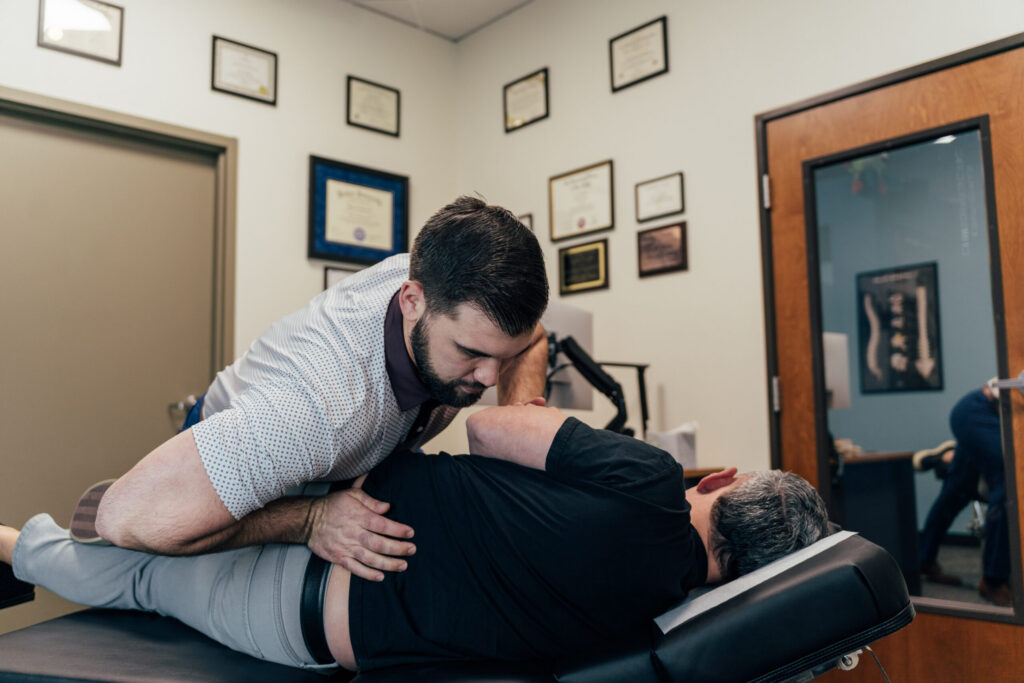
Spinal manipulation and mobilization can help restore proper joint motion, reduce nerve irritation, and alleviate muscle tension that builds up around an injured disc. When applied appropriately and carefully, these techniques can meaningfully reduce pain and help athletes return to sport more quickly.
Therapeutic exercise and rehabilitation are equally important components of chiropractic care for athletes. Simply reducing pain isn’t enough — the underlying movement dysfunction and muscle weakness that contributed to the disc injury in the first place must also be addressed. At Castle Hills Chiropractic, rehabilitation guidance is part of a comprehensive recovery plan.
Soft tissue therapy — including myofascial release and trigger point work — can address the surrounding muscles that become tight and guarded following a disc injury. Reducing this muscular tension helps take additional pressure off the injured disc and speeds recovery.
It’s also worth noting that chiropractic care is not always a standalone solution. For severe disc injuries with significant neurological involvement, Dr. Brent Johnson will coordinate with or refer to other healthcare providers as appropriate. The goal is always the athlete’s long-term health and safety.
Prevention Strategies for Athletes
Prevention is always more effective than treatment, and disc injuries are no exception. The following strategies can dramatically reduce an athlete’s risk of sustaining a disc injury over the course of their career.
Build a strong, well-coordinated core. This doesn’t mean doing endless crunches — in fact, repeated spinal flexion under load can worsen disc stress. Instead, focus on deep core stability exercises like dead bugs, bird dogs, and planks that train the spine to resist unwanted movement. These exercises build the kind of neuromuscular control that protects the discs during athletic activity.
Learn and practice proper movement mechanics. Whether you’re lifting weights, throwing, or running, the way you move matters enormously. Working with a coach or a knowledgeable provider like Dr. Brent Johnson can help identify faulty movement patterns before they lead to injury. Video analysis and movement screening are valuable tools in this process.
Prioritize recovery. Athletes often underestimate the importance of sleep, nutrition, and rest. Discs receive their nutrition through a process of diffusion that depends on adequate hydration and movement. When you’re chronically overtrained, under-slept, or dehydrated, your discs are less resilient. Build structured rest into your training plan.
Don’t ignore early warning signs. A mild ache in the lower back or a slight stiffness after training isn’t something to push through indefinitely. These subtle signals are your body’s way of communicating that something needs attention. Athletes in the Castle Hills, TX area who notice persistent spinal symptoms should seek evaluation sooner rather than later — catching a disc problem early gives you far more treatment options.
When to See a Chiropractor
If you’ve been dealing with back or neck pain that has persisted for more than a few days, or if you’re noticing radiating symptoms like tingling or numbness into your limbs, it’s time to get evaluated. These symptoms don’t always mean a disc is seriously injured, but they do warrant professional assessment. Waiting too long can allow a manageable problem to become a more complex one.
There are also certain red flag symptoms that should prompt immediate medical attention rather than a chiropractic visit. These include loss of bladder or bowel control, severe and rapidly progressing weakness, saddle anesthesia (numbness in the inner thighs and groin), or disc pain following significant trauma. These signs may indicate a serious spinal emergency and require urgent medical evaluation.
For the majority of athletes, however, disc symptoms fall well within the scope of conservative chiropractic care. A visit to Castle Hills Chiropractic in Castle Hills, TX is a great first step toward understanding what’s going on with your spine and getting a clear plan for recovery.
Disc Injury Comparison: Common vs. Serious Signs
|
Sign or Symptom |
Likely Manageable with Conservative Care |
Warrants Urgent Medical Attention |
|---|---|---|
|
Back or neck pain |
Localized, mild to moderate, no nerve involvement |
Severe, sudden onset after trauma, rapidly worsening |
|
Radiating pain |
Intermittent, follows a predictable nerve path |
Constant, severe, with significant muscle weakness |
|
Tingling or numbness |
Mild, comes and goes, limited to one side |
Bilateral, rapidly progressing, involves saddle area |
|
Weakness in limbs |
Mild, improves with rest |
Significant, progressive, affects balance or walking |
|
Bladder/bowel changes |
Not typically present |
Any change — seek emergency care immediately |
|
Pain with movement |
Worse with specific positions, improves with others |
Unrelenting pain in all positions, no relief |
Myths vs. Facts About Disc Injuries
Myth: A herniated disc means surgery is inevitable.
Fact: The vast majority of disc herniations resolve or improve significantly with conservative care, including chiropractic treatment, physical rehabilitation, and time. Surgery is generally considered only when conservative measures have been exhausted and neurological deficits are severe or worsening. Many athletes return to full sport without ever needing an operation.
Myth: Rest is the best treatment for a disc injury.
Fact: Prolonged bed rest has actually been shown to slow recovery from disc-related pain. While short-term relative rest may be helpful in acute flare-ups, controlled movement, gentle rehabilitation, and guided activity are generally more effective for long-term recovery. Movement helps maintain disc nutrition and reduces deconditioning.
Myth: If you have a disc injury, you’ll never be able to play sports again.
Fact: Many athletes successfully return to high-level competition after disc injuries. With proper rehabilitation, movement retraining, and maintenance care, athletes can regain full function and participate in their sport with a well-managed spinal condition. The outcome depends heavily on the type of injury, the severity, and the quality of care received.
Myth: Pain is the only sign of a disc problem.
Fact: Disc injuries can cause a wide range of symptoms beyond pain, including numbness, tingling, weakness, and altered reflexes. Conversely, some people have disc herniations visible on imaging but experience little to no pain. This is why a thorough clinical evaluation — not just imaging alone — is essential for accurate diagnosis and treatment planning.
Myth: Chiropractic care is dangerous for disc injuries.
Fact: When properly evaluated and appropriately managed, chiropractic care is a well-established conservative treatment option for disc-related conditions. Dr. Brent Johnson at Castle Hills Chiropractic conducts a detailed assessment before recommending any treatment, ensuring that the approach is safe and suitable for each individual athlete’s presentation.
Final Thoughts from Castle Hills Chiropractic
Disc injuries are one of those topics that can feel intimidating, especially when you’re an athlete who depends on your body to perform. But understanding what a disc injury actually is — and knowing that there are effective, conservative options available — can transform fear into confidence. You don’t have to accept pain as the price of athletic participation.
Here at Castle Hills Chiropractic, Dr. Brent Johnson has a deep appreciation for the demands that sport places on the human body. The athletes of Castle Hills, TX and the surrounding communities deserve individualized, thoughtful care that gets them back to doing what they love. Whether you’re recovering from an acute disc injury or looking to prevent one, our team is here to help you understand your spine, move better, and stay in the game.
If you or someone you know in the Castle Hills area is dealing with back pain, neck pain, or other spinal symptoms, don’t wait for things to get worse. Reach out to Castle Hills Chiropractic and take the first step toward a healthier, more resilient spine.
Frequently Asked Questions
Can athletes with disc injuries continue to train?
In many cases, yes — though the type and intensity of training may need to be modified during recovery. Dr. Brent Johnson can help determine which activities are safe and which should be temporarily avoided based on your specific injury. The goal is to keep you moving while allowing the disc time to heal.
How long does it take to recover from a disc injury?
Recovery time varies widely depending on the severity of the injury, the athlete’s overall health, and how consistently they follow their rehabilitation plan. Mild disc bulges may resolve in a matter of weeks, while more significant herniations can take several months. Consistent care and guided rehabilitation generally produce the best outcomes.
Is chiropractic care safe for disc herniations?
For most types of disc herniations, chiropractic care is considered a safe and effective conservative treatment option. A thorough evaluation is always conducted first to rule out contraindications. Certain severe cases involving progressive neurological deficits may require medical co-management or referral.
What sports carry the highest risk for disc injuries?
Sports that involve repetitive spinal loading, heavy lifting, or high-impact contact tend to carry elevated disc injury risk. These include weightlifting, football, gymnastics, rowing, golf, and wrestling. That said, disc injuries can occur in virtually any sport, particularly when movement mechanics are poor or recovery is inadequate.
Can chiropractic care help prevent disc injuries in athletes?
Yes. Regular chiropractic care can help identify and correct movement dysfunctions, improve spinal mobility, and address muscle imbalances before they lead to injury. Many athletes in Castle Hills, TX use chiropractic care proactively as part of their injury prevention and performance maintenance routine.
Should I get an MRI before seeing a chiropractor for disc pain?
Not necessarily. Many disc injuries can be accurately assessed through a thorough clinical examination without imaging. Dr. Brent Johnson will determine whether imaging is indicated based on your symptoms, history, and neurological findings. If an MRI or other imaging is needed, a referral will be provided.
TL;DR Summary
-
Disc injuries are common in athletes and range from disc bulges to herniations and degeneration, with symptoms including localized pain, radiating numbness, and weakness.
-
Common causes include repetitive spinal loading, poor movement mechanics, acute trauma, and core muscle weakness.
-
Chiropractic care — including spinal manipulation, rehabilitation exercise, and soft tissue therapy — is a well-supported conservative option for managing and recovering from disc injuries.
-
Prevention strategies include building deep core stability, learning proper movement mechanics, prioritizing recovery, and not ignoring early warning signs.
-
Certain red flag symptoms (bladder/bowel changes, rapidly progressing weakness) require immediate medical attention rather than chiropractic care.